Showing posts with label DIY dice. Show all posts

Wednesday, 26 November 2014

DIY Dice - Idea #4

In a previous post, I talked about filling your classroom with math visuals and manipulatives for little, to no money. One of my suggestions was making your own dice...quiet dice that is!

I found some great foam cubes at my local Dollar Tree, grabbed myself a fine-tip Sharpie, summoned my creativeness, and came up with a few different ways to use them in my math classroom.

If you want to check out the previous DIY dice ideas, you can do so here.

This idea is about 8 months overdue. The resource mentioned in this post was about 85% done...then I had my son...and now you understand the long delay in between this post and my last DIY dice post...

DIY Dice - Idea #4

Algebra Dice 

Again, the thing I love most about using these dice is it allows for easy differentiation. These activities allow students to develop their understanding at their own rate, thus becoming more confident learners. Each set of dice can be slightly different to accommodate each student's abilities. . One group could be working with single digits, one with double digits, etc. Plus, you can easily keep them organized by color-coding them, i.e. single digits are red, double digits are blue, etc.

I also love that the possibilities with these dice are endless. For this set of activities, all you really need are some different number dice, but just for fun I also create some variable dice.


 Create dice with different letters on the sides to represent variables, or 3 x’s and 3 y’s. Students can roll them along with the number dice to create a whole equation.


Here is an activity my students complete with algebra dice.


Students roll the dice to determine the value of x. Using substitution they then solve the equation. If the students are working in partners or groups they can race each other, and then compare answers in order to correct. I think a little competition always helps keep them engaged.

...and here is a game my students play with algebra dice.


Similar to the game of war, students have to use their skills of substitution to determine who has the highest answer.


You can find the whole collection of activities and games using DIY Algebra Dice here. There are over 10 activities and printables included in the pack!


Saturday, 1 February 2014

DIY Dice - Idea #3

I am continuing on with my series called "DIY Dice". If you haven't seen my previous posts you can find them here.

My main goal is to provide you with some alternative ways to make Math manipulatives without breaking your budget, as well as some interactive activities for using your new hand-made manipulatives.

So, another week, another idea. Here is another way I use "do-it-yourself" dice in my Math classroom...

DIY Dice - Idea #3

Integer Dice 


Again, the thing I love most about using these dice is it allows for easy differentiation. These activities allow students to develop their understanding at their own rate, thus becoming more confident learners. Each set of dice can be slightly different to accommodate each student's abilities. . One group could be working with positive integers, one with a negative integers, one with a combination of positive and negative integers, etc. Plus, you can easily keep them organized by color-coding them, i.e. positive integers are red, negative integers are blue, etc.
I also love that the possibilities with these dice are endless. Here are a few ways to create your integer dice. 

1.      Sign Dice – I use these most often as I find they provide the most variety in terms of integers rolled. Students will roll two dice to determine their integer. One die represents the sign (positive sign and negative sign each appear 3 times on the die), and the other the value. If you have already created sets of number dice, you can use either single digit numbers or double digit numbers, depending on your students and the activity. 

2. Positive/Negative Dice – I make sets of dice where all the integers on one die are positive, and the numbers are random between 1 and 9, alternatively I create sets where all the integers are negative. These are helpful when you want students working on a particular skill, such as subtracting negative numbers. 


3. Combination Dice- These sets of dice include random positive and negative integers between 1 and 9. You could also use double digit numbers if you wanted.


Here are some sample activities in progress.


...and here is a sample game to play with integer dice.


You can find the whole collection of activities and games using DIY Integer Dice here. There are over 12 activities and printables included in the pack!

I hope you have been enjoying these posts and have found some ways to incorporate DIY dice in your own classroom. I would love to hear about them.

Stay tuned for another way I use DIY dice next week!


Friday, 24 January 2014

DIY Dice - Idea #2

I am continuing on with my series called "DIY Dice". If you haven't seen my previous post you can find it here.

My main goal is to provide you with some alternative ways to make Math manipulatives without breaking your budget, as well as some interactive activities for using your new hand-made manipulatives.

So, another week, another idea. Here is another way I use "do-it-yourself" dice in my Math classroom...

DIY Dice - Idea #2

Fraction Dice 


As I have said before, the thing I love most about using these dice is it allows for easy differentiation. These activities allow students to develop their understanding at their own rate, thus becoming more confident learners. Each set of dice can be slightly different to accommodate each student's abilities. One group could be working with unit fractions, one with fractions with common denominators, one with mixed numbers, etc.


I also love that the possibilities with these dice are endless. Here are a few ways to create your fraction dice.


1.      Unit Fraction dice – All fractions on these dice will have a numerator of one. You can choose which denominators you want to include. I usually stick to 2 main groupings. Either, 1/2, 1/3, 1/4, 1/5, 1/6, and 1/7 or  1/2, 1/3, 1/4, 1/6, 1/8, and 1/12. Depending on what level your students are, you may want to only include 3 different fractions per die; therefore each fraction will appear twice on each die. I.e. 1/2, 1/3, 1/4, 1/2, 1/3, 1/4.


2.      “Most commonly used fractions” dice – Randomly select commonly used fractions to put on each face of the die. Use any of the following 1/2, 1/4, 3/4, 1/5, 2/5, 1/10, 1/3, or 2/3.


3.      Numerator and denominator dice – I use these most often as I find they provide the most variety in terms of fractions rolled. Students will roll two dice to determine their fraction. One die represents the numerator (the whole number), and the other the denominator. There are multiple ways to use these dice.

a.      Proper fractions – create proper fractions by keeping the whole number low, I use the digits 1, 2, and 3 twice on one die, and you can choose the denominators based on your students’ abilities. The only time they might get an improper fraction is if they roll a 3 and a */2. If they are capable of working with it great, if not, simply get them to roll again.


b.      Improper Fractions – create improper fractions using higher single digits, or double digit numbers for the numerator die.


c.      Common denominators – When completing any adding and subtracting activities (or ordering), you will need to decide whether your students will work with common denominators or not. If you want your students to work with common denominators simply tell them to roll the denominator die once, and the numerator die twice (or more).


4.      Mixed numbers Dice – create mixed numbers by rolling a single digit number die with a die option from either #1 or #2 above. 


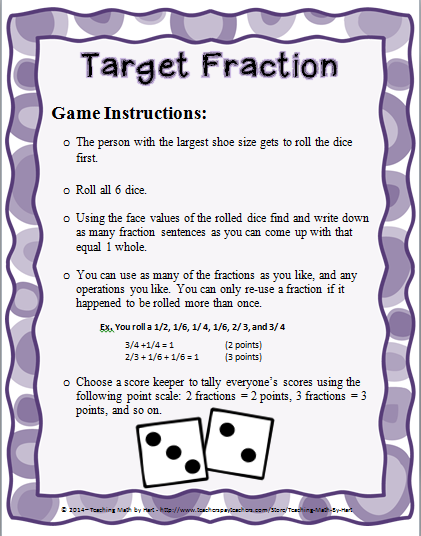
Here is a sample activity and a sample game I do with fraction dice.


You can find the whole collection of activities and games using DIY Fraction Dice here. There are over 15 activities and printables included in the pack!

Stay tuned for another way I use DIY dice next week!


Saturday, 18 January 2014

DIY Dice - Idea #1

In a previous post, I talked about filling your classroom with math visuals and manipulatives for little, to no money. One of my suggestions was making your own dice...quiet dice that is!

I found some great foam cubes at my local Dollar Tree, grabbed myself a fine-tip Sharpie, summoned my creativeness, and came up with a few different ways to use them in my math classroom.

So I've decided to start a little series called "DIY Dice".

Once a week I am going to tell you about an activity that I use in my own classroom that uses some form of "do-it-yourself" dice.

DIY Dice - Idea #1

Number Dice 

This certainly isn't anything new, using different digits on the side of dice, however by creating your own, you aren't limited by what digits you use. You can easily get your hands on multiple sided dice with 2 digit numbers, but they come with a pretty steep price tag, and this is all about making Math manipulatives for cheap, cheap, cheap!

The other thing I love about using these dice, is it allows for easy differentiation. Each set of dice can be slightly different to accommodate each student's abilities. One group could be working with single digits, one with a combination of single and double digits, one with double digits, one with triple digits, etc. Plus, you can easily keep them organized by color-coding them, i.e. single digits are red, double digits are blue, etc.

There are a few ways to create your number dice.


1.      Single digit dice – Obviously you only have 6 sides to work with, and 10 possible digits (0-9). It all depends on what you want your students to be working on. Ex. A student needs to work on his/her multiplication facts for 2, 3, and 4. On one die, you only put the digits 2-4 (each digit will appear twice on the die), the other die has random digits between 2-9 (a couple will get left out, but that’s why you have more dice)


2.      Double digit dice – Again, with only 6 sides you are quite limited in what numbers you can use. To give my students more variety for the activities, I have tried out a few different techniques.
a.      I make a set of dice where each die has the same value in the tens place. Ex. One die has random numbers between 10-19; another has random numbers between 20-29, etc.


b.      Roll 2 single digit dice to make a double digit. Ex. A student rolls a 5 and a 9. He/she can choose to use the number 59 or 95.

c.      Increase number sense skills my incorporating what your students know about expanded form and place value. 1 die has single digits (your choice of 0-9), the second die has multiples of 10 (10, 20, 30, 40, etc). Ex. If a student rolls a 30 and a 4, he/she will use the number 34.


          3.      Triple digit dice, and so on…
a.      Use techniques b and c from the double digit dice. The amount of dice the student rolls will depend on how many digits you want him/her to work with.


Here is a sample activity and a sample game I do with number dice.


You can find the whole collection of activities and games using DIY Number Dice here. There are over 15 activities and printables included in the pack!

Stay tuned for another way I use DIY dice next week!


Wednesday, 8 January 2014

How to fill your math classroom with visuals and manipulatives...on a budget

As some of you know from previous posts, I am a very frugal person. If there is a cheaper way of doing something, I will find it! This not only helps me out in my personal life, but also my teaching life. I know I am not alone, when I admit to often looking at something destined for the garbage and think "How could I use that in my classroom?" Anyone else guilty of this?

When it comes to teaching math, I find using any kind of visuals and/or manipulatives to be a huge benefit to many of my students. However, a lot of these hands-on items cost a small fortune in the Math supplies catalogs and teacher stores. So....when I can, I make my own, or enlist the kids to help make them.

This is my "Math Cart" (made by my talented husband), and almost everything in it is made by me, except for some dice, cards, and cube-a-links. Looking at this picture, reminds me that I really should label each bin accordingly.


Here is a quick list of some of the things that fill up this cart.

- all my centers (including directions, and any supplies required to complete them)
- all my number lines
- all my bingo cards (one for just about every concept I teach)
- all my matching games and concentration/memory games  (one for just about every concept I teach)
- all my "I have, who has?" cards (one for just about every concept I teach)
- all my task cards ( I've just started this collection and hope to have a set for each concept I teach by the end of the year)
- all my 3-D shapes for my geometry unit (paper ones used to represent solid shapes, and wire ones used to represent the skeleton of the shape)
- all my place value tents for teaching expanded form.
- film canisters filled with numbered bingo chips (used for my Making Numbers warm-up)
- 2 bins are filled with magazines, as the students are always using them for activities in their Math Scrapbooks
- and more...

Looking at this list, I wonder where I ever found the time. These items have all been collected over my almost 10 years of teaching, and most were done before I had my own children. But, let's face it, creating, cutting, gluing, laminating, and cutting again, takes time. Since discovering TpT, adding to my math cart has become a lot easier and less time consuming.


Two things I use constantly in my room are cards and dice.


Decks of cards are easy enough to come by and are fairly cheap. What's better than cheap? FREE! Call up your local casino and ask if they would be willing to donate their used cards to your classroom. Did you know that they are only allowed to use a deck of cards once? After that, they usually get hole-punched to signify that they have been used, and they are free for the taking. Luckily this year I have a parent who works at a casino, so I get them delivered right to my class by one of my students. She politely pointed out that my decks were looking a little worn and thought I could use some new ones.

*Helpful tip - To make sure your decks do not get mixed up (especially if they are all the same brand), make sure to number them in the top-back corner. Makes for easy re-organizing, when those random cards inevitably get left on the desk or floor somewhere.


Dice, are also fairly easy to come by and also reasonably priced. I love all the different ones you can get these days. 10-sided, 20-sided, etc. However, they are still pretty limited in what you can do with them, especially when you get into the higher grades. So I started making my own dice.

My mom, a retired elementary teacher gave me the idea for quiet dice! One of the disadvantages I find about dice, is they are noisy, and half the time the kids roll them so hard that they roll off the desk on to the floor...sometimes never to be seen again!

I realized that if I made my own dice, the possibilities are endless, as I can put whatever I want on the 6 sides. I started by making them out of old toothpaste or cracker boxes, wrapping, and "laminating" with packing tape. Here are the directions from a resource of mine.
I found these fairly successful, but even with the laminating they don't hold up long term.

Last month I found a fantastic alternative. I came across these foam blocks (50 in a pack) at my local Dollar Tree for $1.25! They are basically the same size as standard dice, maybe a bit larger, and I can make them into whatever kind of dice I want with a fine-point permanent marker! I was sold, so I cleared the shelf of them!


Over the next couple of weeks I will be posting ideas on DIY dice that can be used for specific topics in your math classroom.
I would love to hear your ideas as well.
Stay tuned!


If you happen to be heading to the Texas Middle School Association Annual Conference, you just might get your own set of DIY dice. My blogging friend Michele Martin Luck from A Lesson Plan for Teachers, will be there with a great display of TpT products and has graciously offered to put some of my dice packs in the goodie bags for those who stop by her booth. Make sure to hunt her down if you are there!